
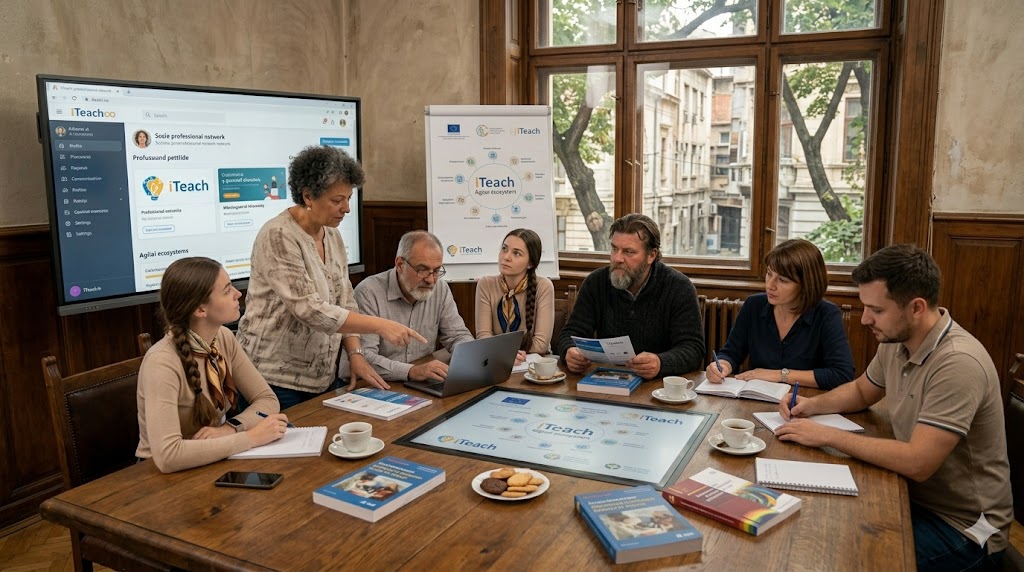

Institute for Education, Bucharest, March 2026 –
In today’s knowledge-based society, the competences of teachers are a fundamental determinant of educational quality. Consequently, providing educators with relevant, flexible, and ongoing professional development (PD) opportunities has become a systemic priority. Research indicates that viable mechanisms for continuous teacher training, aligned with the rapid pace of pedagogical and technological innovation, are among the most important factors for achieving deep and lasting improvements in education (Darling-Hammond et al., 2017; Fullan, 2008).
Against this backdrop, the iTeach ecosystem was launched in 2010 as an integrated solution for teacher professional development in Romania. Developed by the Institute for Education (Bucharest) in partnership with the tech company Social IT, the iTeach platform – accessible via iteach.ro and its equivalent suntprofesor.ro – has grown to become the country’s most comprehensive digital community for teachers (EduPedu, 2023). As of 2026, it brings together a dynamic community of over 37,000 registered teachers and a library of more than 15,000 open educational resources (OER) (EduVox, 2026) – figures that reflect continuous growth since the 30,000 members and 11,000 resources documented in 2023 (EduPedu, 2023). This large-scale uptake underscores the platform’s national impact and reach, and has led to iTeach being highlighted as a model initiative in European analyses of digital technology use in education (EduPedu, 2023).
From the outset, iTeach was designed with a clear mission: to provide a one-stop ecosystem addressing teachers’ professional needs in a holistic manner. It combines formal online courses with informal learning, coaching, peer collaboration, and resource sharing. Rather than viewing teacher development as a one-off event, iTeach embodies the understanding that effective teacher learning is an ongoing, multifaceted process (Istrate, 2011). Well-structured courses grounded in the reality of the Romanian classroom form one pillar of this process, but equally important are collegial exchange, participation in projects, reflective practice, and the creation of teaching materials. This aligns with modern PD principles: research shows that the most effective teacher development programmes focus on content-specific pedagogy, active learning, collaboration, modeling of effective practices, coaching and expert support, quality feedback, and sufficient duration to internalize new strategies (Darling-Hammond et al., 2017). The iTeach ecosystem was carefully built around these evidence-based principles, aiming to foster sustained professional growth and tangible improvements in teaching practice.
In the sections below, we provide a detailed overview of each component of the iTeach ecosystem, explaining its role and function and connecting it to relevant literature on teacher professional development. We also review the outcomes and impact of the iTeach programme over its 16 years of implementation (2010–2026), and highlight the aspects that make this ecosystem innovative and forward-thinking in the context of digital education.
Components of the iTeach Ecosystem
The iTeach Platform (iTeach.ro and suntprofesor.ro)
The iTeach platform – accessible via both iteach.ro and suntprofesor.ro – is the core of the ecosystem, functioning as a comprehensive online professional community exclusively for educators (EduPedu, 2023). Teachers create a free account and join a network where they can learn, share, and document their professional development journey. Key features of the platform include (EduPedu, 2023):
- Online training courses – short, focused programmes available free of charge and on-demand, with downloadable completion certificates. The courses cover domains relevant to contemporary teaching practice, including digital pedagogy, assessment, classroom management, inclusion, and more.
- Open-access educational journals where teachers can publish articles with ISSN registration, such as the EDICT journal and Revista Profesorului (detailed below).
- Resource creation and sharing tools – notably, integration with the DigitalEdu platform, enabling teachers to create, upload, and share OER and design complete digital learning units or sequences for their classes.
- Access to educational databases and repositories, including collections of teaching guides, research papers, and policy documents relevant to education.
- Social networking features for professional exchange: each teacher has a personal blog space (over 5,800 blog posts have been written by teachers so far), can form or join thematic groups (400+ groups), create polls (2,500+ polls with over 50,000 cumulative responses and comments), and participate in forums and debates (500+ discussion threads).
- A digital professional portfolio for every member, integrated into the platform’s “My Resources – Portfolio: My Profile” section, where teachers can compile evidence of their professional growth – including earned certificates, created resources, published articles, and records of classroom practice – in one online profile (EDICT, n.d.-b).
Through this rich feature set, iTeach serves as far more than a course portal; it is essentially a professional hub where Romanian teachers can engage in continuous development. A teacher can enrol in a course, download the completion certificate, apply new strategies in the classroom, write a reflective article about the experience, share a lesson plan as an OER, and discuss outcomes with colleagues – all within the same integrated environment. The community aspect is reinforced by the platform’s closed-network nature (only verified educators can join), ensuring discussions and content remain focused on educational practice in a trusted space (EduPedu, 2023).
Theoretical foundations. The design of iTeach is grounded in modern theories of teacher learning. As Istrate (2011) noted when conceptualizing the programme, continuing professional development is a “complex process” that goes beyond formal courses to include collegial exchange, pedagogical research, and the publication of materials derived from classroom practice. This perspective aligns with adult learning theories, which emphasize the importance of social context and reflection in professional growth. In line with Lave and Wenger’s (1991) concept of communities of practice, the online socio-professional network provided by iTeach enables authentic peer learning and the sharing of good practices. The platform’s points system – a form of recognition for activities such as completing courses, contributing resources, or commenting in forums – serves as an indicator of engagement and growing expertise, turning the platform into a living environment of professional exchange rather than just a document repository (EduPedu, 2023). In practice, teachers accumulate points and digital badges that reflect their participation and contributions; this not only motivates ongoing involvement but also helps surface active contributors who can act as mentors or role models within the community.
Another important feature is how iTeach bridges formal and informal PD. Teachers can earn formal professional credits through accredited courses while simultaneously gaining value from informal interactions – a balance that mirrors what research identifies as key to deep teacher learning: a mix of structured learning and job-embedded, collaborative learning (EDICT, n.d.-a).
During its development, iTeach forged a broad coalition of partners. The project was led by an NGO (Institute for Education) in partnership with a private IT company (Social IT), but with active support from the Ministry of Education and educational research institutions. This triangulation allowed it to be agile and tech-savvy while maintaining credibility and alignment with national goals, suggesting a model for implementing educational innovations at scale through multi-sector partnerships rather than through a single institutional effort.
As early as 2010, the Ministry of Education designated iTeach as the national pivot platform for teacher training in digital pedagogy, piloting innovative courses such as Collaboration in the Digital Classroom and Project-Based Approaches – drawn from the international Intel Teach programme and adapted to the Romanian context (Adevărul, 2011; EduPedu, 2023). This public–private approach and the commitment to internationally recognised, high-quality content were themselves an innovation, establishing a model of partnership worth emulating in education (Adevărul, 2011).
DigitalEdu.ro and Ariadna.app – Open Educational Resources (OER)
A key component of the iTeach ecosystem is DigitalEdu.ro, an open educational resource repository and authoring platform designed to promote the creation and sharing of digital teaching materials. Launched in 2015 by the Institute for Education in collaboration with Social IT (Educația Digitală, 2026), DigitalEdu serves as a centralized database of teacher-created resources organized by subject and grade level. It hosts well over 15,000 digital resources by 2026 – ranging from interactive worksheets and quizzes to educational games, simulations, and videos (EduVox, 2026), with a figure of over 11,000 resources documented in 2023 (EduPedu, 2023). All resources are freely accessible to any teacher, aligning with the principles of the global OER movement which emphasize free access, open licensing, and the capacity to adapt materials for local needs.
Crucially, DigitalEdu.ro not only archives resources but also provides an online editor and tools for teachers to develop new content. One standout tool integrated into the ecosystem is Ariadna.app – an innovative web application created specifically to simplify the production of interactive learning content. Ariadna allows educators to build engaging multimedia lessons and entire learning pathways for their students, supporting collaborative editing, embedding of videos and quizzes, SCORM export for LMS compatibility, and analytics on student usage (DigitalEdu, n.d.). In essence, Ariadna is a powerful authoring tool that turns teachers into content creators without requiring advanced technical skills (DigitalEdu, n.d.). Resources created on Ariadna, or on other popular platforms (Genially, LearningApps, Wordwall, etc.), can be uploaded to DigitalEdu.ro, where they undergo a quality validation process before being made publicly available to the entire teaching community (EduVox, 2026).
The focus on OER within iTeach is grounded in the idea that sharing teaching resources amplifies innovation and reduces teacher isolation. Research on OER in education suggests that teacher involvement in creating and curating open resources can lead to improved lesson design and a deeper understanding of curriculum content, as educators must think critically about pedagogy when preparing materials for others (Istrate, 2021). Moreover, using digital OER in the classroom often requires teachers to rethink traditional instructional approaches, which can result in more student-centred, engaging learning experiences. Istrate (2021) argues that incorporating a digital open resource into a lesson inherently calls for instructional redesign – the teacher may need to alter the flow of the lesson, integrate technology-mediated activities, or allow for more student interaction – all of which can benefit student engagement and learning. Furthermore, communities of practice that form around resource creation platforms tend to generate sustained professional dialogue: teachers share not only resources but also instructional scenarios, application ideas, and mutual feedback, leading to the continuous improvement of both materials and teaching practices.
In summary, DigitalEdu.ro and Ariadna.app extend the iTeach ecosystem into the domain of curricular resources, ensuring that teachers have not only the knowledge from courses and research but also concrete tools and materials to apply new methods in the classroom. This component underscores a fundamental innovation of iTeach: treating teachers as active producers of educational content and knowledge, rather than merely consumers. By enabling teachers to create and share OER, iTeach empowers them to contribute directly to the improvement of education nationwide, consistent with UNESCO’s vision for OER as a driver of teacher development and educational quality (UNESCO, 2019).
Educational Journals and Knowledge Sharing: EDICT, Revista Profesorului, and Experiențe didactice
Another distinctive element of the iTeach ecosystem is its emphasis on amplifying teacher voice and fostering a culture of scholarly reflection through open-access educational publications. The platform actively encourages teachers not only to read professional literature but also to become contributors to it by writing about their own practice and insights. There are several outlets within the ecosystem for such publication:
EDICT – Revista Educației (edict.ro) is an open-access journal established by the Institute for Education. It publishes articles (in Romanian and English) on topics such as pedagogy, classroom innovation, educational technology, and policy. Articles are editor- or peer-reviewed, and the journal issues are registered with ISSN, lending academic credibility. Many contributors are practising teachers sharing classroom research or practical innovations in a format that connects practice to theory.
Revista Profesorului (revistaprofesorului.ro) – “The Teacher’s Journal” – is an online publication spearheaded by the Centre for Development and Innovation in Education (iEdu) in Iași, an organization associated with the iTeach network. Aimed at bridging theory and practice, it features articles by educators and researchers; for instance, Preda (2026) discusses the theoretical foundations of the teacher’s professional portfolio and highlights the iTeach platform as a model in the context of new national regulations.
iTeach – Experiențe didactice (Teaching Experiences) is a section on the iteach.ro platform that has served as an online compendium of teacher case studies and practice-sharing since the early years of the programme. Istrate’s (2011) foundational article, which laid out the underlying concepts of iTeach as a framework for continuing teacher professional development, was published in issue 9 of this series. Over the years, successive issues of Experiențe didactice have collected real-world narratives of classroom innovation from teachers across Romania.
These publications play a crucial role in the ecosystem by providing a platform for teacher reflection and thought leadership. Encouraging teachers to document their experiences in a public, formalized way helps cultivate a reflective stance towards teaching. According to Edgerton et al. (1991), the process of selecting and commenting on one’s teaching artefacts as part of creating a teaching portfolio or article is itself a powerful act of comprehensive self-evaluation. Wolf and Dietz (1998) similarly found that teacher portfolios and teacher-authored articles reveal a multidimensional view of teaching competence, and that the very act of assembling them fosters deeper reflection than relying solely on student test scores or external evaluations. By writing for EDICT or Revista Profesorului, teachers essentially engage in practitioner research – they analyse what worked or did not work in their practice, relate it to educational theories or frameworks, and share conclusions that others can learn from.
With over 6,000 teacher-written articles published across the ecosystem’s open-access journals to date (EduPedu, 2023), iTeach has effectively created one of the largest bodies of practitioner-oriented educational literature in Romania. This is a significant outcome: it demonstrates that teachers, given the opportunity and support, are eager to engage with research and contribute insights, helping to close the gap between academic educational research and classroom practice.
These publications also tie the ecosystem to national education priorities. When the Ministry of Education drafted a framework methodology for the teacher’s professional portfolio in 2026 (Ministerul Educației al României, 2026), analyses and recommendations from iTeach community members were already available: Preda (2026) explicitly connected theory to the iTeach model, showing policymakers a working example of an integrated portfolio, while an iTeach editorial team article in Educația Digitală (Educația Digitală, 2026) explained how to develop and manage such a portfolio in practice. This shows the bidirectional influence: the iTeach ecosystem not only aligns with and anticipates policy changes, but through its publications it actively informs and shapes discussions around those policies.
In summary, the educational journals and writing opportunities offered by iTeach are innovative in that they elevate teacher agency and reflective practice. They transform teachers from passive recipients of knowledge into active contributors and local experts, in line with modern views on teacher leadership. As Darling-Hammond et al. (2017) note, extended professional development with direct applicability and opportunities for reflection significantly increases the quality of curriculum implementation – and the act of writing for a broader audience is as reflective and applied as PD can be.
EduVox – Educational News and Innovation Platform
EduVox.ro is an educational news and outreach platform associated with the iTeach ecosystem, serving as a bridge between the internal teacher community and the wider public discourse on education. While the main iTeach platform is an exclusive space for registered teachers, EduVox is open-access and targets a broader audience: educators (including those not yet on iTeach), school leaders, parents, education professionals, and decision-makers. Its mission is to disseminate information about educational innovations, opportunities, and success stories, thereby raising awareness and engagement in the field of educational development.
EduVox fulfils several roles. It announces new courses and training sessions – for instance, highlighting the launch of free iTeach online courses or new cohorts for existing courses. In mid-2023, an EduVox article reported that over 800 teachers registered within weeks for a course on creating and using digital educational resources (EduVox, 2026) – evidence of both high demand and the platform’s reach in publicizing opportunities. It also shares analysis and opinion pieces on educational trends, often written by members of the iTeach team or invited experts, covering topics such as digital education best practices, summaries of research (including DigCompEdu digital competence reports), and thought pieces on pedagogy and policy (Educația Digitală, 2025). In addition, a widely shared EduVox article from March 2026 (EduVox, 2026) synthesizes the philosophy of the iTeach ecosystem for a public audience, positioning it as the most comprehensive digital educational ecosystem developed to support teachers in Romania, and thus raising the programme’s profile beyond its immediate user base.
By operating in the open web domain, EduVox serves as the outward-facing voice of the iTeach ecosystem, ensuring that knowledge and success stories are shared broadly and that a more informed and supportive environment for teacher development is maintained at the system level.
Digital Competence Assessment – DigCompEdu and digcompedu.ro
Developing and recognizing teachers’ digital competences is a strategic focus for the iTeach ecosystem, reflecting the broader educational shift toward digital literacy and integration. In alignment with the European Digital Competence Framework for Educators (DigCompEdu), iTeach offers tools and resources to help teachers assess and improve their digital skills.
On the iTeach/suntprofesor platform, educators have access to self-assessment instruments for digital competence mapped to the DigCompEdu framework (EduVox, 2026). These tools present statements or scenarios across the six key areas of DigCompEdu – ranging from Professional Engagement and Digital Resources to Teaching and Learning, Assessment, Empowering Learners, and Facilitating Learners’ Digital Competence. By completing the self-assessment, teachers can identify their proficiency level – from Newcomer or Explorer up to Leader or Pioneer – in each area. The platform then provides feedback or suggestions for learning resources and courses to address weaker areas.
The integration of DigCompEdu into iTeach anticipated national policy developments. In mid-2022, the Ministry of Education officially adopted a Digital Competence Framework for Education Professionals based on DigCompEdu, through Order no. 4150 of June 29, 2022 (Ministerul Educației al României, 2022). This policy move means that teachers in Romania are expected to develop across the DigCompEdu competency areas, and evidence of digital skills may factor into evaluations or certification. The iTeach ecosystem effectively provides a ready-made solution for teachers and schools to meet these expectations: it not only familiarizes educators with the DigCompEdu descriptors (through digcompedu.ro) but also directly links them with training opportunities. The “Digital Competences for Teachers” online courses offered on iTeach explicitly align with the DigCompEdu framework, covering practical uses of digital platforms, tools for online safety and digital citizenship, and strategies for integrating technology into teaching and assessment (EduVox, 2026). Likewise, the iTeach digital portfolio captures many elements of DigCompEdu – such as evidence of Professional Engagement through courses or digital learning materials created by the teacher – serving as a way for teachers to demonstrate their growth in each competency area (EDICT, n.d.-b).
The importance of such an integrated approach is highlighted by data: a report on Romanian teachers’ digital competences based on DigCompEdu (May 2025) found that teachers on average scored 53.6%, corresponding to an intermediate proficiency level (Educația Digitală, 2025). Strengths were noted in areas like professional development and reflective practices, but significant gaps were found in collaborative learning and more advanced pedagogical uses of technology (Educația Digitală, 2025). This suggests that while many teachers have embraced basic digital tools, they need more support in leveraging technology for deeper instructional transformation. The iTeach ecosystem addresses these needs on multiple fronts: courses that tackle higher-order digital pedagogy (e.g., project-based learning with technology), tools that encourage collaboration (forums, group projects in courses), and the very notion of being part of an online community of practice that inherently boosts one’s ability to learn collaboratively online.
Results and Impact (2010–2026)
Scale and Reach of the Ecosystem
One of the most striking results is the growth of the iTeach community. From a modest start of around 5,000 teacher users in 2011 (Adevărul, 2011) – already an indication of latent demand, given that number was achieved within the first year of operation – the platform expanded rapidly. By late 2023, iTeach counted over 30,000 teachers as members (EduPedu, 2023), and by early 2026 this figure reached approximately 37,000 (EduVox, 2026). For context, Romania’s entire pre-university teaching corps numbers roughly 200,000, meaning roughly one in six teachers in the country has an iTeach account. Such penetration is rare for a voluntary professional platform, underscoring iTeach’s perceived value among educators.
Notably, the growth has been accompanied by geographical and demographic breadth. Early data indicated that about 40% of the users were from rural areas and over half were above 45 years old (Adevărul, 2011) – groups that traditionally face more barriers to professional development. The platform’s online nature and free access effectively levelled the playing field. As one rural teacher noted, iTeach was like “an outstretched hand” that made access to training easier in situations where attending in-person courses in cities was not feasible (Adevărul, 2011). This impact in terms of equity – ensuring that opportunities reached those who needed them most – is one of the programme’s most significant, if least visible, achievements.
Alongside membership growth, the volume of content and activity on iTeach underscores its dynamic use. Teachers have collectively contributed a vast repository of knowledge: over 5,800 blog posts, 400+ discussion groups, and posts in over 2,500 polls and 500 forum debates (EduPedu, 2023). In terms of formal outputs, the community has generated over 6,000 open-access articles registered with ISSN (across EDICT, Revista Profesorului, etc.) (EduPedu, 2023) and over 15,000 teaching resources on DigitalEdu (EduVox, 2026), representing a remarkable crowdsourcing of educational content and wisdom.
In relation to training delivery, by 2023 a total of 35 distinct online courses had been made available to teachers, free of charge (EduPedu, 2023). These courses cover a spectrum of needs, from digital literacy and content creation to modern pedagogy and classroom management. The average completion rate stands at around 30% (EduVox, 2026). While this might appear moderate, it is on par with or higher than typical completion rates for voluntary online courses worldwide. Moreover, the figure speaks to the rigour of the courses – they require significant work (e.g., designing lessons, reflecting in writing, passing assessments), which means those who complete them have engaged deeply with the content. The value of the iTeach certificates is recognized because of this rigour, as evidenced by the fact that teachers include them in their professional portfolios and CVs, and school inspectors accept them as evidence of continuous education.
An important dimension of iTeach’s reach is how it influenced the culture of teacher professional development in Romania. By achieving scale, iTeach normalized the idea of online, self-driven PD among Romanian teachers. When the COVID-19 pandemic forced a sudden shift to remote work and training in 2020, the community that iTeach had already built was accustomed to online collaboration and learning. This resilience and responsiveness highlight the programme’s impact not only in steady-state conditions but also in times of crisis – it provided an existing infrastructure and community that could be leveraged to navigate new challenges.
Improvements in Teaching Practice and Professional Growth
Beyond numbers, the true impact of iTeach is reflected in qualitative improvements in teaching practice and teacher professionalism. Many teachers have adopted new student-centred methods, integrated technology into everyday teaching, and improved their assessment techniques thanks to ideas gained from courses or colleagues. As one history teacher described, after finishing the Project-Based Learning course, the group of participants he had learned with “evolved into a small community that promotes education through virtual means,” inspiring him to create a virtual forum for his students to discuss historical topics, significantly enriching his teaching practice (Adevărul, 2011). Such testimonies indicate a transfer of training: skills and attitudes gained through iTeach activities have been applied in classrooms, benefiting students through more engaging and modern learning experiences.
Another impactful dimension is how iTeach has supported the creation of a professional portfolio culture among teachers. Through the platform’s portfolio feature and the emphasis in courses on reflecting and documenting one’s work, teachers became more accustomed to continuously collecting evidence of their growth. This proved prescient when the Ministry of Education introduced a policy requiring professional teaching portfolios for career milestones starting in 2027 (Ministerul Educației al României, 2026). Because of iTeach, thousands of teachers had already digitized their professional footprint – including certificates from courses, examples of lesson plans, digital badges, published articles, and notes on extracurricular activities – all in a format that is easily shareable and verifiable. The formal structure set by the ministry is essentially mirrored by what iTeach offers (Preda, 2026): in pilots of the new evaluation process, teachers who were active on iTeach could readily present a rich portfolio without scrambling to assemble documents. The bureaucratic burden is dramatically reduced, and more importantly, the portfolio’s content is of higher quality, focusing on authentic evidence of teaching competence rather than administrative paperwork (Preda, 2026).
There have also been shifts in mindset and motivation among educators participating in iTeach. The ecosystem’s design – encouraging self-improvement, peer recognition through points and comments, and visibility for one’s work – has contributed to a more empowered teacher identity. Many educators, especially those in isolated areas, have expressed that being part of a national teacher network made them feel less alone in confronting challenges and more confident in trying out new ideas. This is critical because, as Fullan (2008) and others argue, lasting change comes when teachers are not merely complying with training, but are genuinely invested in continuous learning. The widespread adoption of new tools and strategies by iTeach teachers has had positive effects on student engagement, though direct causal attribution between teacher PD and student outcomes would require further empirical study. What research does confirm is that teacher learning opportunities with practical classroom application correlate with better curriculum implementation (Cohen & Hill, 2001, as cited in Fullan, 2008) – and the evidence of changed practices among iTeach teachers is consistent with this finding.
Recognition, Scalability, and Sustainability
The iTeach ecosystem’s success has been recognized at multiple levels. Internationally, iTeach was highlighted as a case study in European reports on digital education innovation (EduPedu, 2023) – placing Romania on the map as a contributor to teacher development innovation and potentially attracting further support and collaboration opportunities.
Nationally, the programme gained the trust of key institutions. The Ministry of Education’s early decision to designate iTeach as a central hub for teacher training in digital skills was a significant vote of confidence (Adevărul, 2011; EduPedu, 2023). Over the years, County Teacher Training Centres (CCD) in various regions have partnered with iTeach to host or accredit certain online courses, embedding the platform into the formal PD system (Adevărul, 2011). This blending of non-formal and formal PD sectors is a strong indicator of sustainability: it suggests the ecosystem is not an isolated project that fades when initial funding ends, but rather a robust part of the educational fabric that adapts and endures.
Indeed, iTeach has been sustained for 16 years – a remarkable lifespan for an education project – through continuous adaptation, volunteerism of contributors, and a hybrid funding model (grants, partnerships, and nominal service offerings) that kept it afloat without charging users. From a policy perspective, iTeach has proven the viability of several concepts that were previously untested at large scale in Romania: e-learning for teachers, OER contribution, digital credentialing, and online communities of practice. Its success provided evidence that these approaches can work, which likely influenced educational stakeholders to be more receptive to integrating technology in PD and in student learning contexts.
Innovative Dimensions of the iTeach Ecosystem
Several aspects make the iTeach ecosystem stand out as an innovative model for teacher professional development:
Holistic integration of PD components. Perhaps the most fundamental innovation of iTeach is treating teacher development as an ecosystem rather than a series of isolated activities. By building a platform that integrates courses, communities, resource repositories, publishing opportunities, and portfolios, iTeach addressed the multifaceted nature of teacher growth that research advocates (Darling-Hammond et al., 2017). This contrasts sharply with traditional PD systems that might offer workshops and nothing more. The seamless interplay – for example, a teacher takes a course, then writes an article about it, then adds it to a portfolio, and earns points that unlock further opportunities – fosters synergies that reinforce learning at each step.
Community of practice at national scale. iTeach was one of the first large-scale implementations of an online community of practice for teachers in Romania (Adevărul, 2011). Leveraging principles from social networking, it created a space where teachers could engage daily in professional conversations, something that previously might happen only during sporadic face-to-face meetings. The innovative element was not just using forum technology, but actively curating and moderating the community so that it remained constructive and focused. The introduction of game-like elements (points, badges) to encourage participation was also relatively pioneering in the context of professional communities.
Empowering teachers as creators and contributors. Conventional PD often positions teachers as passive recipients of expertise. iTeach flipped this paradigm by empowering teachers to be content creators (through OER) and knowledge contributors (through publications). This recognizes and harnesses teachers’ tacit knowledge and anticipates the contemporary notion of teachers as “learning designers” and “researcher-practitioners.” It had a concrete practical effect as well: a continuous stream of Romanian-language teaching resources and case studies became available, addressing local curriculum and context – something that international resources could not directly provide.
Recognition of informal learning and micro-credentials. The iTeach points system and certificate management introduced a novel way to recognize learning achievements. While traditional systems rely solely on formal credits and diplomas, iTeach implemented a more granular recognition: every action (completing a course module, publishing a resource, etc.) is acknowledged. This anticipates the contemporary movement towards micro-credentialing and digital badges in education, and over time created an informal currency of professional development that peers and supervisors alike came to respect.
Public–private and cross-sector collaboration. The way iTeach was developed and sustained is itself innovative. It was neither a fully top-down government project nor a grassroots teacher movement; it was a hybrid led by an NGO (Institute for Education) with a key technology partner (Social IT), embraced by state institutions. This model allowed the programme to benefit from public sector legitimacy and reach, private sector agility and technological expertise, and civil society’s closeness to teachers’ needs – a potential blueprint for future educational initiatives (Adevărul, 2011; EduPedu, 2023).
Adaptive evolution and foresight. The iTeach ecosystem showed a capacity to anticipate future needs and incorporate them ahead of time. Focusing on teacher digital competences well before they became mandated, and building the architecture for professional portfolios long before the portfolio policy was enacted, are prime examples. By 2023–2024, the iTeach support team was experimenting with AI tools to streamline help-desk queries and administrative tasks (EduVox, 2026), indicating a forward-thinking culture akin to how an innovative technology project operates. This continuous evolution – new courses to address current topics, new site features, integration with tools like Ariadna – reflects a commitment to remaining at the forefront of teacher development.
Open access and free participation. By committing to open-access principles (both for resources and journals) and not charging teachers, iTeach removed financial and accessibility barriers that had historically characterized continuing professional education in Romania. The sustainability was ensured through creative use of volunteer moderators, crowdsourced content, and in-kind support from partner institutions. This model has since been emulated by other smaller-scale teacher communities and open educational initiatives.
Overall, the innovative dimensions of iTeach can be summarized as creating a 21st-century learning ecosystem for teachers, by teachers. It broke down silos – between different regions and school types, between theory and practice, and between pre-service and in-service development – and demonstrated that a holistic, community-driven, technology-enabled approach can serve as a potential blueprint for reforming teacher professional development in other contexts.
Conclusion
The iTeach ecosystem demonstrates a compelling model of how to support and elevate the teaching profession in the digital age. By interweaving online courses, resource sharing, collaborative networking, and scholarly reflection, it addresses the full spectrum of professional development needs in a way that is accessible, scalable, and effective. The experience of iTeach offers several key takeaways:
Teachers thrive in a community of practice. When given the tools to connect and collaborate, teachers eagerly learn from one another. The success of iTeach’s community features validates the concept that professional learning is often most impactful when it is social and peer-driven (Lave & Wenger, 1991; Istrate, 2011).
Relevance and practicality are crucial. The popularity of iTeach’s courses and resources can be attributed to their grounding in real classroom challenges and modern pedagogical solutions. This underscores Darling-Hammond et al.’s (2017) findings that effective PD connects to teachers’ day-to-day practice.
Recognition and motivation matter. iTeach’s approach to acknowledging every teacher’s effort – whether through a certificate, a digital badge, or a comment from a colleague – created a positive feedback loop. In a profession that can sometimes feel thankless, such recognition is motivating and leads to a more enthusiastic uptake of professional development opportunities.
Alignment with policy can amplify impact. The forward-looking alignment of iTeach with the DigCompEdu framework and the teacher portfolio requirement proved beneficial for all parties – teachers were ready for new policies, and policymakers had a tested model to refer to. This suggests that involving innovative projects in policy development can lead to more realistic and implementable policies.
For decision-makers, investing in and supporting ecosystems similar to iTeach could yield high returns in teacher quality. The iTeach model shows that a relatively small infrastructure – a web platform and a lean team – can mobilize and uplift a large workforce when it taps into intrinsic motivations and professional ideals. It also highlights the importance of partnerships: no single institution could have achieved this alone, but together an NGO, a technology partner, educational authorities, and teachers themselves built something enduring.
In conclusion, the iTeach ecosystem, since its inception in 2010, has been a pioneering and empowering force in Romanian education. It effectively anticipated the needs of a 21st-century teaching workforce and met those needs with innovation, collaboration, and a commitment to openness. As one editorial statement from the iTeach team captures it, investment in such continuous development is “not merely an opportunity, but a strategic decision” for the quality of education (Educația Digitală, 2026) – one that has already begun to pay dividends, and will continue to do so as the ecosystem evolves and inspires new innovations in teacher professional development.
References
Adevărul. (2011). Profesorii se întâlnesc pe platforma online iTeach [Teachers meet on the iTeach online platform]. Adevărul. https://adevarul.ro/stiri-interne/educatie/profesorii-se-intalnesc-pe-platforma-online-iteach-1033351.html
Cohen, D. K., & Hill, H. C. (2001). Learning policy: When state education reform works. Yale University Press.
Darling-Hammond, L., Hyler, M. E., & Gardner, M. (2017). Effective teacher professional development. Learning Policy Institute. https://learningpolicyinstitute.org/product/effective-teacher-professional-development-report
EDICT – Revista Educației. (n.d.-a). iTeach online courses: A continuous professional development pathway for Romanian teachers. EDICT. https://edict.ro/iteach-online-courses-a-continuous-professional-development-pathway-for-romanian-teachers/
EDICT – Revista Educației. (n.d.-b). The teacher’s professional portfolio: Theoretical foundations and practical applications. EDICT. https://edict.ro/the-teachers-professional-portfolio-theoretical-foundations-and-practical-applications/
Educatia Digitala. (2023). The iTeach Ecosystem in Romania – A Comprehensive Digital Infrastructure for Teacher Professional Development. Educatia-digitala.ro. https://educatia-digitala.ro/the-iteach-ecosystem-in-romania-a-comprehensive-digital-infrastructure-for-teacher-professional-development/
Educația Digitală. (2025). DigCompEdu: Competențele digitale ale cadrelor didactice [DigCompEdu: Digital competences of teachers]. Educatia-digitala.ro. https://educatia-digitala.ro/eticheta/digcompedu/
Educația Digitală. (2026). Cursurile online iTeach: Un parcurs de dezvoltare profesională continuă pentru cadrele didactice din România [iTeach online courses: A continuous professional development pathway for Romanian teachers]. Educatia-digitala.ro. https://educatia-digitala.ro/cursurile-online-iteach-un-parcurs-de-dezvoltare-profesionala-continua-pentru-cadrele-didactice-din-romania/
Edgerton, R., Hutchings, P., & Quinlan, K. (1991). The teaching portfolio: Capturing the scholarship in teaching. American Association for Higher Education.
EduPedu. (2023). Peste 30.000 de profesori se întâlnesc în iTeach, cel mai complex ecosistem educațional digital dezvoltat pentru a sprijini cadrele didactice – o bibliotecă cu 11.000 de resurse educaționale deschise [Over 30,000 teachers meet on iTeach, the most comprehensive digital educational ecosystem developed to support teachers – a library of 11,000 open educational resources]. EduPedu. https://www.edupedu.ro/peste-30-000-de-profesori-se-intalnesc-in-iteach-cel-mai-complex-ecosistem-educational-digital-dezvoltat-pentru-a-sprijini-cadrele-didactice-o-biblioteca-cu-11-000-de-resurse-educationale-deschise/
EduVox. (2026). Cursurile online iTeach: Formare profesională continuă de calitate într-un ecosistem digital integrat [iTeach online courses: Quality continuous professional training in an integrated digital ecosystem]. EduVox. https://eduvox.ro/cursurile-online-iteach-formare-profesionala-continua-de-calitate-intr-un-ecosistem-digital-integrat/
Fullan, M. (2008). The six secrets of change: What the best leaders do to help their organizations survive and thrive. Jossey-Bass.
Istrate, O. (2011). Repere ale inovării educaționale: Programul iTeach pentru formarea continuă a cadrelor didactice [Landmarks of educational innovation: The iTeach programme for continuing teacher professional development]. iTeach: Experiențe didactice, 9. https://iteach.ro/experientedidactice/repere-ale-inovarii-educationale-programul-iteach-pentru-dezvoltarea-profesionala-continua-a-cadrelor-didactice
Istrate, O. (2021). Resurse educaționale deschise. [Open educational resources]. Revista Profesorului. https://revistaprofesorului.ro/resurse-educationale-deschise/
Istrate, O. (2026). The iTeach Ecosystem Analysis: A Decade and a Half of Innovation in Teacher Professional Development in Romania (2010–2026). EDICT- Revista educatiei 5/ 2026. Available online https://edict.ro/the-iteach-ecosystem-analysis-a-decade-and-a-half-of-innovation-in-teacher-professional-development-in-romania-2010-2026/
Lave, J., & Wenger, E. (1991). Situated learning: Legitimate peripheral participation. Cambridge University Press. https://doi.org/10.1017/CBO9780511815355
Ministerul Educației al României [Ministry of Education of Romania]. (2022). Ordinul nr. 4150 din 29 iunie 2022 privind aprobarea cadrului de competențe digitale pentru personalul didactic din România [Order No. 4150 of June 29, 2022, on approving the digital competence framework for teaching staff in Romania]. Ministerul Educației al României.
Ministerul Educației al României [Ministry of Education of Romania]. (2026). Metodologie-cadru privind portofoliul profesional al cadrului didactic [Framework methodology on the teacher’s professional portfolio]. Ministerul Educației al României.
Preda, M. (2026). Portofoliul profesional al cadrului didactic: Fundamente teoretice și aplicații practice [The teacher’s professional portfolio: Theoretical foundations and practical applications]. Revista Profesorului. https://revistaprofesorului.ro/portofoliul-profesional-al-cadrului-didactic-fundamente-teoretice-si-aplicatii-practice/
UNESCO. (2019). Recommendation on open educational resources (OER). UNESCO. https://www.unesco.org/en/legal-affairs/recommendation-open-educational-resources-oer
Wolf, K., & Dietz, M. (1998). Teaching portfolios: Purposes and possibilities. Teacher Education Quarterly, 25(1), 9–22.
* * *
The image was generated with Gemini 3.
